
OPINION
WHEN THE SHOVEL MEETS THE CHEQUE: GALAMSEY AND THE PARADOX OF THE POISONED RIVER

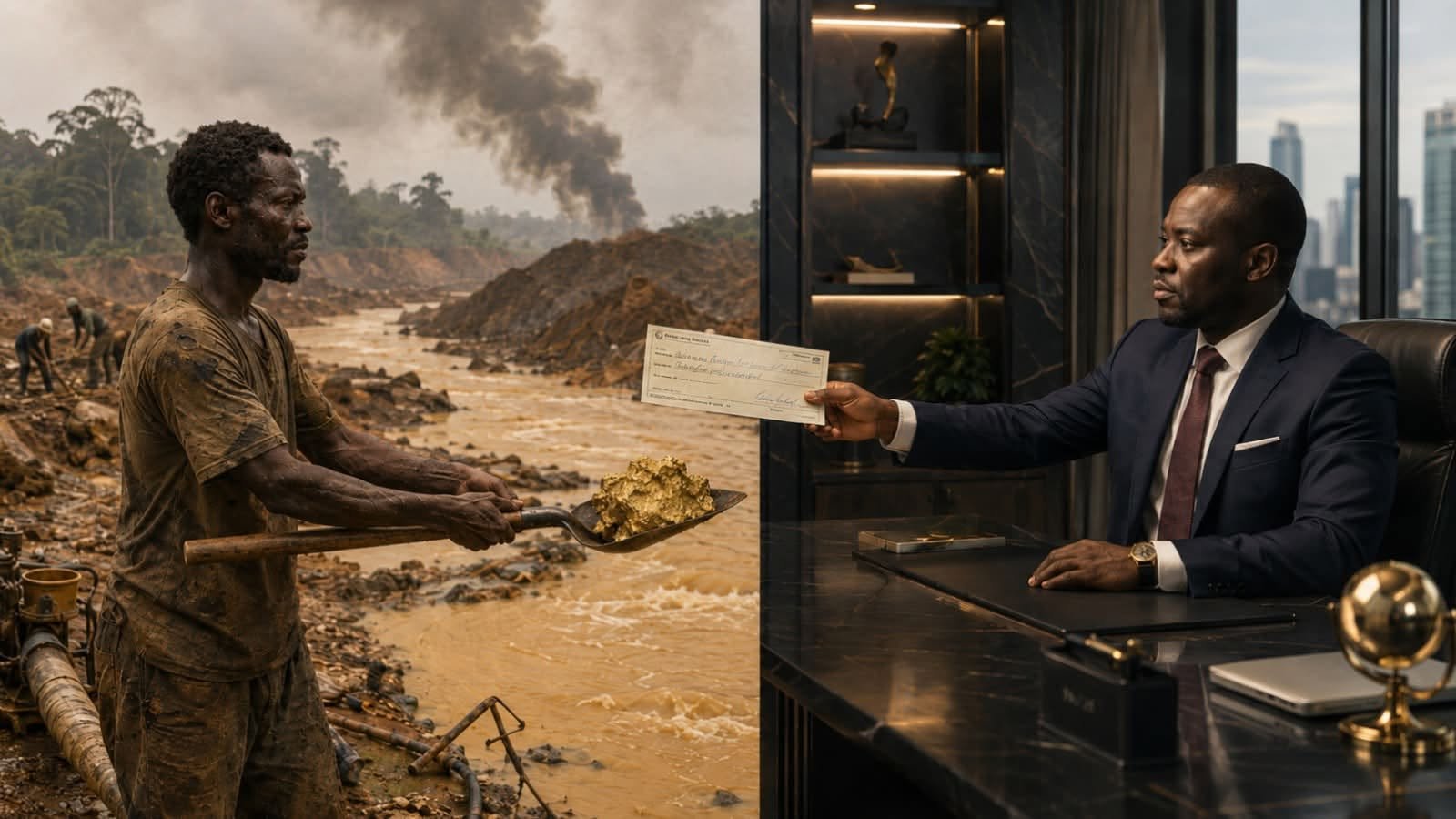
Galamsey has undoubtedly become one of Ghana’s most persistent national embarrassments. We have spoken about it, demonstrated against it, campaigned on it, formed task forces around it, deployed security personnel against it and exchanged political accusations over it. Civil society organisations have issued statements.
Traditional leaders have been blamed. Politicians have blamed one another. Governments have promised action. Journalists have been harassed. Communities have cried out. Yet the rivers continue to die. The land continues to be scarred. And the galamseyers continue to have a field day.
Perhaps, after all these years, we have been asking an incomplete question. We keep asking: Who is doing the illegal mining? Maybe we should also ask: Who buys the illegal gold? That question sounds almost too simple. But perhaps that is precisely why it is uncomfortable.
Gold is not cassava. It is not mined because the miner will take it home, boil it and feed his family with it. Gold is not like palm wine, which the tapper brings home and sells at the town square. Gold is mined because somebody somewhere is waiting to pay for it. Every gram extracted from a polluted river eventually enters a transaction. It is bought, aggregated, transported, tested and turned into real money.
The river becomes brown. The forest disappears. The farmer loses his land. The community loses its water. But strangely, the gold itself seems to disappear without a trace. Where does it go? That is the question Ghanaians must begin to ask with greater seriousness. “If you do not know where the rain began to beat you, you will not know where you dried your body.”
Perhaps this is where our anti-galamsey fight has gone wrong. We have become so consumed with the mud on the galamseyers’ feet that we have not sufficiently followed the gold beyond the pit. We know where the shovel is. But do we know where the cheque is?
For years, the man with the shovel has been made the face of galamsey. Television cameras show him waist-deep in muddy water; security forces chase him off, excavators are seized and burnt, and politicians declare, “We are fighting galamsey.”
But what about the person waiting somewhere with the money? We have become very good at chasing the person carrying the shovel while paying too little attention to the person carrying the cheque. The galamseyer may be the most visible person in the chain, but he is obviously not the most powerful. Who is more powerful?
The man standing inside the river with a shovel, or the person who has enough money to buy everything that man produces? The person holding the shovel may be poor; the person holding the cheque may never even see the river. Yet without the cheque, what exactly is the shovel digging for?
This is the paradox at the heart of the galamsey menace. The shovel is dirty; the cheque is clean. The shovel is visible; the cheque is hidden. The shovel enters the river; the cheque sits comfortably in an office. But when the shovel meets the cheque, destruction becomes business. So, this question must be asked: Who buys the poisoned gold? If there were no market for illegally mined gold, how long would galamsey survive? Ghana has spent too much time policing the shovel while insufficiently interrogating the cheque.
The state has sought to regulate the buying, selling and export of gold. But if illegally mined gold is still being produced every day, where is it going? Gold does not evaporate. The problem is no longer simply one of illegal mining; it is also one of traceability and accountability. Can every ounce entering the formal market be confidently traced to a lawful, environmentally compliant source? That question must be asked without political colouring.
This is not an NDC or an NPP question. It is a Ghana question. A poisoned river does not distinguish between government supporters and opposition supporters, and the child who drinks contaminated water is not protected by a party card.
The second question Ghana must confront is more disturbing. What has emboldened these people so much? There was a time when illegal activity at least attempted to hide.Today, in some places, the brazenness is astonishing: mining machinery destroying a community’s surroundings in broad daylight, close to homes, farms, roads and schools, while people watch helplessly. “The goat does not get lost while the owner is watching.” Yet here we are. Either the owner is not watching, or the goat has learnt that being watched no longer matters.
People do not openly violate laws unless they believe something about the consequences. Perhaps they believe enforcement will not last, that political connections matter more than regulations, or that profits are high enough to absorb the occasional loss as a cost of doing business.
Whatever the explanation, one thing is clear: Impunity has become a form of capital. Once people believe the law can be negotiated, delayed or survived, illegality becomes normal, and that is when a country should worry. When an illegal miner feels confident enough to destroy a river or a forest in broad daylight, the deeper question is what he knows about the state’s willingness and ability to stop him.
Every time galamsey becomes topical, we seem to rediscover it as though it began yesterday. Committees are formed. Task forces are announced. Press conferences are held. Then the national temperature falls. But the excavator does not forget its way back to the forest, and the buyer does not forget the price of gold. The market remains, and the cycle begins again.
Perhaps this is why Ghana has made little progress in the fight against galamsey. We attack the pits instead of dismantling the purchasing power that keeps it profitable. Galamsey is a problem of systems, incentives, markets, political protection and collective silence.
As long as somebody is willing to finance the operation, buy the gold, move it and convert it into acceptable wealth, the river will remain vulnerable. This is why “Who buys the gold?” must become central to the national discourse, not because every buyer is guilty, but because a serious anti-galamsey strategy must account for the entire chain through which gold moves from the earth to the market.
Traceability cannot stop at the person who presents the gold for sale; it must reach back to the land it came from. “The river that forgets its source will eventually lose itself.” And so must our gold-trading system remember its source. Every ounce must have a story. Every story a location. Every location a legal and environmental identity.
What exactly is development if, in our search for gold, we destroy the ecological foundations life depends on? What does it profit a country to increase its gold exports and lose its rivers? What does it profit a country to have a stronger exchange rate and lose its green forest? We speak as though the environment and the economy are separate conversations. They are not.
A river is an economic asset, and clean water is national wealth. Their value may not appear daily on the foreign-exchange dashboard, but their destruction will eventually produce a bill — a huge one that Ghana will pay. Maybe not today, but a generation will. We are sitting on a time bomb.
The danger is not merely that some rivers are already polluted, but that we may normalise their destruction until restoration becomes extraordinarily expensive, or impossible. And when that day comes, the people who bought the gold may have moved on, the excavators may have rusted, and the gold itself will be sitting comfortably in vaults and investment portfolios, far from the communities it came from. But the community will still need water. The farmer will still need land. The child will still need a future. We kept asking who is mining illegally.
Perhaps we should also have been asking who is buying, who is financing, who is protecting, who is looking away, and who benefits when the river dies – because every gram of galamsey gold eventually meets money. When the shovel finally meets the cheque, the transaction is completed.
The shovel may be muddy, and the cheque may be clean, but the river connects both. Follow the money backwards, and perhaps we will finally meet the system destroying the river. Until then, we will keep arresting shovels while the cheque waits patiently for the next consignment.
The Pra will suffer. The Birim will suffer. The Ankobra will suffer. And we will keep holding conferences about what everybody can already see.
Gold can be sold. Gold can be exported. Gold can be stored. Gold can appreciate in value. But a dead river cannot be bought back. Connect the Shovel to the Cheque!
Prof. Evans Asante, University of Education, Winneba eyasante@uew.edu.gh